
For Korean families considering hockey in the United States, USA Hockey’s new Development League raises two immediate questions: can my child participate, and would joining improve the plan for their hockey and education?
Those questions lead to different answers for a player arriving from Korea, a player already on a U.S. team, and a goalie without U.S. citizenship. They also depend on where the family is looking. A league that fills a gap in one region may offer less additional value in Boston, where established prep schools and clubs provide other routes.
At Northstar Education Group, we evaluate the DL within the whole plan for the student: eligibility, coaching, school, living arrangements, and the family’s total commitment. The announcement is a reason to review that plan carefully.
Scheduled to begin in 2027–28, the Development League will have 15U and 17U teams. Its standards call for an average of at least three on-ice practices and two off-ice training sessions per week, along with qualified goaltending and strength and conditioning coaches. Teams will play 40–55 regular-season games, at least 60% against DL opponents. USA Hockey’s league overview
For Korean athletes, eligibility is the first decision point. Each DL team may roster up to two non-U.S. citizens. Those players must have registered with USA Hockey and played on a USA Hockey team in a prior season. Goalies must be U.S. citizens. DL Guidebook, Section F
For a family planning a first move from Korea, eligibility needs to be established before school or housing decisions depend on a DL opportunity. Families already in the U.S. should ask the club to confirm the player’s eligibility and the roster opportunity being discussed. A school placement and a hockey roster place are separate commitments.
The appeal is a more consistent daily development environment. Regular practice, physical preparation, and demanding competition are also part of what families value in a strong prep hockey program. That makes prep school a useful comparison when evaluating the DL.
The educational side needs equal attention. At a prep school, hockey sits within a larger school experience, with teachers, classmates, academic expectations, and activities beyond the rink. A DL family needs to understand how its particular club will accommodate school. Academic arrangements may vary: TPH, for example, is offering both online coursework and a supervised, on-site academy model to support DL programs. TPH’s academic options
For a student moving from Korea, the questions are practical: who helps when English becomes a barrier in class, who notices missed assignments, and who supervises the student outside hockey hours? A family managing the move from overseas needs clear answers about school and adult support alongside the training schedule.
Where strong alternatives are scarce, the potential benefit is easier to see. If a player already travels long distances for suitable competition, a DL program could make that commitment more productive through better instruction and a more coherent schedule. Colorado Thunderbirds describes its participation as a way to strengthen development opportunities close to home. Colorado’s explanation
That benefit is strongest for a family already living near the program. A Korean student moving overseas will still need a school, a place to live, and dependable adult support. The family should compare complete arrangements in each location. A large city can have limited hockey options, while a smaller community can have an excellent program; the quality of the actual placement matters.
Boston’s established programs give families a demanding benchmark. Belmont Hill, Milton Academy, St. Sebastian’s, Thayer Academy, and Noble and Greenough are among the region’s prep hockey options. Admission, tuition, and roster opportunities limit access, but their presence changes the comparison for families who can realistically consider them. NEPSAC program listing
Consider a Korean student who has settled into school, is gaining confidence in English, receives good coaching, and plays a meaningful role on a prep team. A DL offer should be evaluated against those specific advantages. Stronger competition could help, but the family needs to understand whether the move also improves instruction and playing opportunities enough to justify any disruption to school and daily life.
Another player may lack a suitable prep placement or need a different hockey environment. For that family, a DL program could be a good fit. The Boston Jr. Eagles organization is among the 29 invited programs, so the league is already part of the region’s planning conversation. USA Hockey’s invitation list
For clubs, joining changes the program they offer. Under the guidebook, DL organizations cannot also field separate 15O or 16U Tier I teams. DL players are also generally restricted from playing for another hockey team during the same season, with specified exceptions. A family should therefore treat DL and a separate prep varsity season as competing commitments. DL Guidebook, league composition and player eligibility
For a club that prepares players for prep school or serves them around their school season, that creates a real business and development decision. It must be confident it can attract enough families who want a full-season alternative and deliver an experience worth choosing. An organization with a successful role in the local prep system may see less reason to change its model than one already built around full-season hockey.
For Korean families already in a club’s younger age groups, the practical step is to ask what next season’s team options will be. A good experience in the current program should lead to a specific conversation about the next placement, including eligibility, school, and the expected playing role.
The travel budget raises the standard the program must meet. For this analysis, we are using a working estimate of $20,000–$30,000 per season for club fees, travel, hotels, and related competition expenses. This is a budgeting assumption, not published DL pricing.
Actual fees and travel will vary by program. USA Hockey requires a team fact sheet covering fees and schedules; families should use it to build a budget around the proposed calendar. USA Hockey’s parent information
For a student moving from Korea, the estimated DL budget is only the hockey portion. School tuition, housing, English-language support, and flights between Korea and the U.S. may add substantially to the total. Prep tuition and available financial aid belong in the comparison too. Families need the full cost of each viable education and hockey plan.
For a player who already has suitable competition nearby, every additional travel weekend needs a purpose. A worthwhile trip can provide a level of challenge the player needs. Repeated trips that offer little improvement can consume money and time that might otherwise support practice, schoolwork, or rest. The proposed calendar should make that tradeoff visible.
The DL could strengthen youth hockey where families need better options. For Korean athletes, its usefulness will depend first on eligibility and then on the quality of the whole placement. In Boston, established prep and club options give families a strong basis for comparison.
A move makes sense when the student can thrive at school, develop on the ice, and receive dependable support away from home—and when the family can sustain the full commitment.
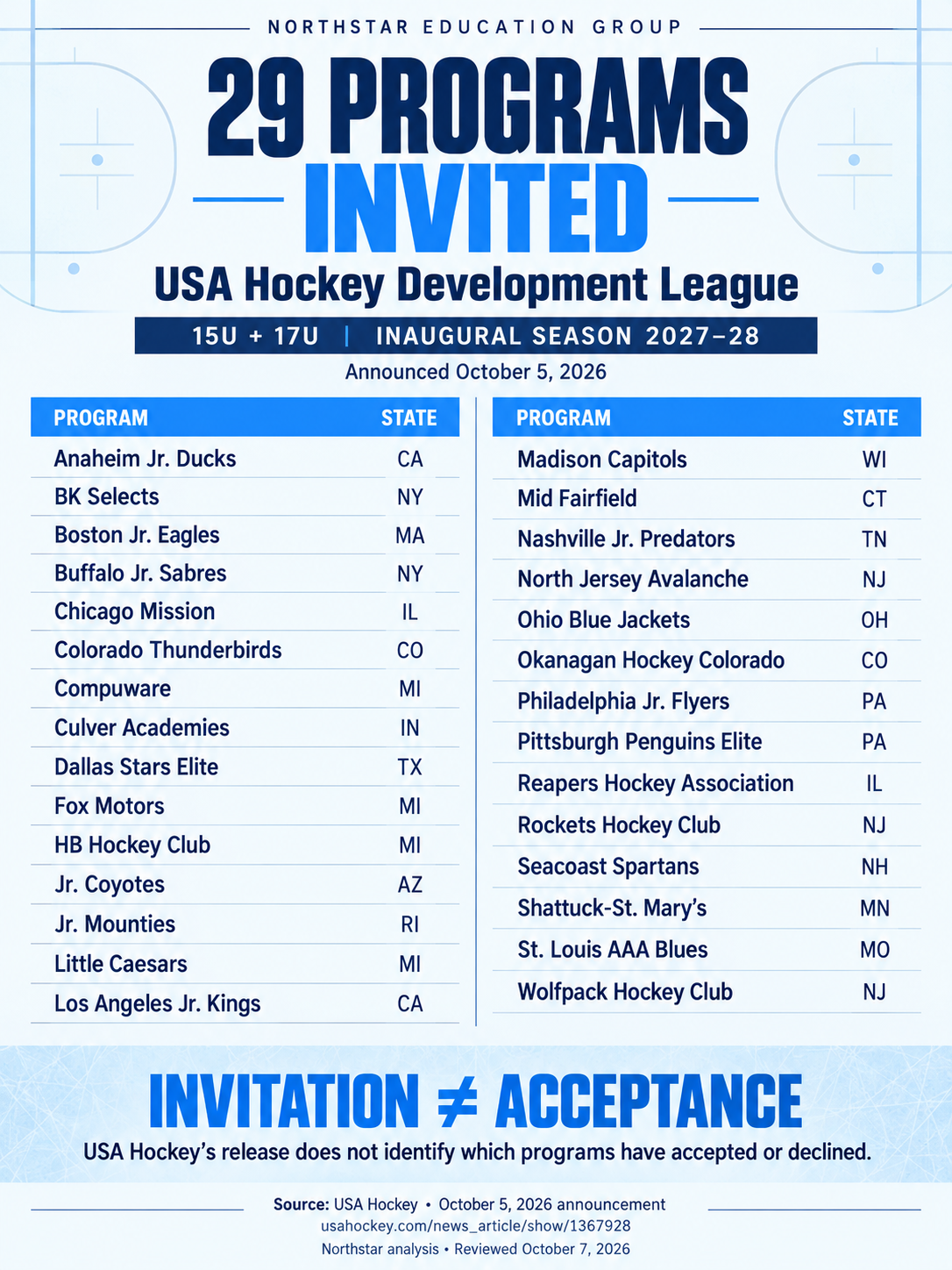
View all 29 invited programs as text
All entries below are invited in USA Hockey’s October 5, 2026 announcement. The announcement does not specify acceptance or decline status. Official source
| Program | State |
|---|---|
| Anaheim Jr. Ducks | CA |
| BK Selects | NY |
| Boston Jr. Eagles | MA |
| Buffalo Jr. Sabres | NY |
| Chicago Mission | IL |
| Colorado Thunderbirds | CO |
| Compuware | MI |
| Culver Academies | IN |
| Dallas Stars Elite | TX |
| Fox Motors | MI |
| HB Hockey Club | MI |
| Jr. Coyotes | AZ |
| Jr. Mounties | RI |
| Little Caesars | MI |
| Los Angeles Jr. Kings | CA |
| Madison Capitols | WI |
| Mid Fairfield | CT |
| Nashville Jr. Predators | TN |
| North Jersey Avalanche | NJ |
| Ohio Blue Jackets | OH |
| Okanagan Hockey Colorado | CO |
| Philadelphia Jr. Flyers | PA |
| Pittsburgh Penguins Elite | PA |
| Reapers Hockey Association | IL |
| Rockets Hockey Club | NJ |
| Seacoast Spartans | NH |
| Shattuck-St. Mary's | MN |
| St. Louis AAA Blues | MO |
| Wolfpack Hockey Club | NJ |
Reviewed October 7, 2026. The $20,000–$30,000 figure is an editorial planning estimate. The invitation graphic is based on USA Hockey’s October 5 announcement and will need revision as participation is confirmed.